

The real constraint on growth is rarely tax. More often, it is cash flow, structure, decision-making and value creation.
By Ramoni Tijani ACA
Founder & Principal Adviser, Northwyn Accounting & Advisory
Founder & Principal Adviser, Northwyn Accounting & Advisory
Every business owner eventually asks:
“How can I pay less tax?”
It is a sensible question.
Tax is a cost. Like any cost, it deserves attention.
But there is a problem.
Many founders start with tax before they have built the business that tax planning is supposed to protect.
I regularly see business owners spend considerable time debating incorporation, remuneration structures and marginal tax savings while far bigger issues remain unresolved:
- Weak cash flow
- Unpredictable profits
- Poor management information
- Compressed margins
- Weak pricing discipline
- Customer concentration
- No clear growth strategy
The result is often a business that is technically tax-efficient but commercially fragile.
And a fragile business rarely creates substantial long-term wealth.
The Question Most Founders Ask
The conversation often starts with:
“How do I reduce my tax bill?”
A better question is usually:
“How do I create more value?”
One question focuses on preserving wealth.
The other focuses on creating it.
The order matters.
The £5,000 Problem
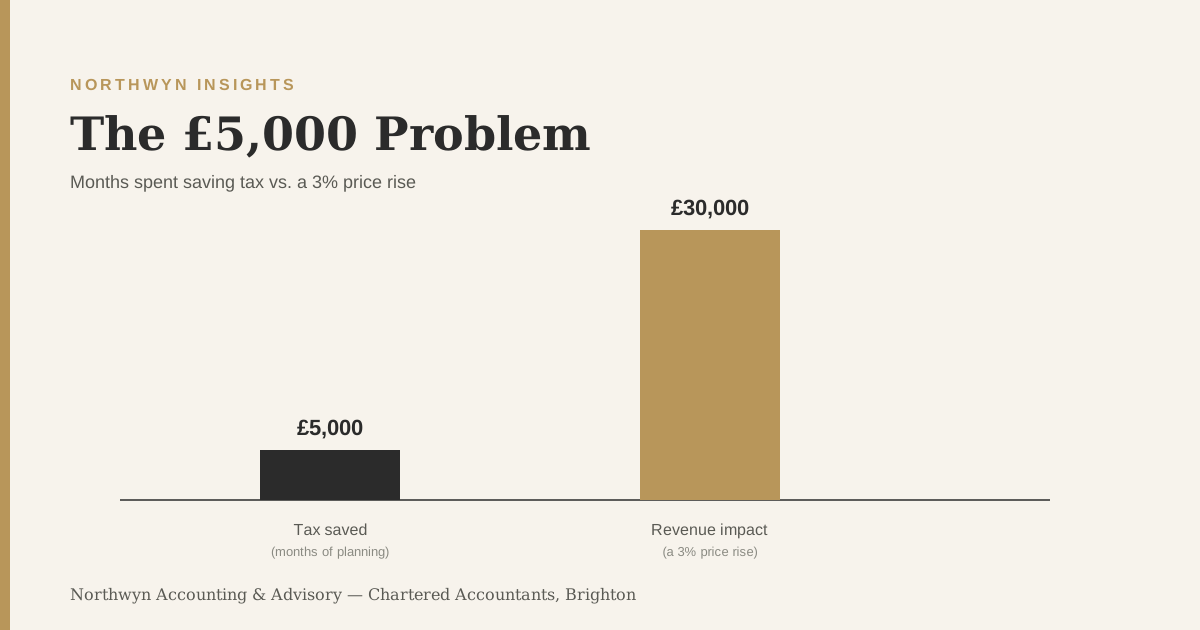
Consider a business generating £1 million of annual revenue and £100,000 of profit.
The owner spends months implementing planning designed to save approximately £5,000 of tax.
The tax bill falls.
Success.
But imagine the same business increased prices by 3%.
If demand remained broadly stable, revenue could increase by £30,000.
Even after allowing for costs and customer attrition, the economic impact may significantly exceed the tax saving.
The point is not that tax planning is unimportant.
The point is that many founders focus on optimisation before they focus on economics.
A stronger business model usually creates more wealth than a better tax structure.
Revenue Creates Attention. Profit Creates Options. Cash Creates Survival.
This is one of the most important financial lessons a founder can learn.
A business can appear profitable and still experience financial stress.
Why?
Because accounting profit is not the same thing as cash in the bank.
Customers pay late.
Working capital absorbs cash.
Debt must be serviced.
Tax liabilities become payable.
Commercial reality ultimately matters more than accounting profit.
Before pursuing aggressive tax planning, founders should understand:
- Cash conversion
- Working capital
- Customer profitability
- Debt obligations
- Forecasting
- Cash runway
These are often the true constraints on growth.
The Three Stages Of Financial Maturity
Stage One: Survival
Win customers.
Generate cash.
Build systems.
Become consistently profitable.
Tax efficiency matters.
But survival matters more.
Stage Two: Structure
Once profitability becomes more reliable, different questions emerge:
- Should the business operate through a company?
- How should ownership be structured?
- How much capital should remain in the business?
- What remuneration approach is appropriate?
At this stage, structure can create substantial long-term value.
But structure should support strategy.
It should never become the strategy.
Stage Three: Strategic Wealth Planning
Eventually the conversation becomes broader.
Founders begin considering:
- Property ownership
- Investment structures
- Succession planning
- Exit readiness
- Wealth preservation
- Intergenerational wealth transfer
The objective is no longer:
“How much tax can I save this year?”
It becomes:
“How do I build, protect and preserve wealth over decades?”
That is a much better question.
The Capital Markets Lesson
Investors rarely focus first on tax efficiency.
They focus on value creation.
Predictable cash flows.
Strong governance.
Scalable operations.
Quality earnings.
Founders benefit from viewing their businesses through the same lens.
Because over time, the market rewards value creation far more consistently than marginal optimisation.
Wealth Is Built Through Ownership
Most significant wealth is not created through tax planning.
It is created through ownership.
Ownership of:
- A growing business
- Valuable equity
- Property
- Investment assets
- Intellectual property
Tax planning can improve outcomes.
But it rarely creates the underlying wealth.
Ownership does.
Ask The Investor’s Questions
If an investor were considering investing £1 million into a business, would their first question be:
“How tax-efficient is the structure?”
Probably not.
More likely:
- Is revenue predictable?
- Are margins attractive?
- Is cash generation strong?
- Is management capable?
- Can the business scale?
- Is there a path to increasing enterprise value?
Those questions tell us something important.
The value of a business ultimately depends on the quality of the business.
Tax planning can support that value.
It cannot substitute for it.
The Northwyn View
At Northwyn, we think about founder wealth through six lenses:
Earn
Build sustainable profit.
Protect
Reduce unnecessary risk.
Structure
Create appropriate ownership arrangements.
Scale
Increase enterprise value.
Exit
Prepare for future transactions.
Preserve
Retain and transfer wealth across generations.
Tax sits within that framework.
It is important.
But it is only one component of wealth creation.
Beyond Tax
At Northwyn, we help founders, directors and property investors think beyond compliance and make better financial decisions across tax, structure, growth and long-term wealth planning.
If you’re questioning whether your current structure supports where you’re trying to get to, that is usually the right time to step back and look at the bigger picture.
The Founder Question That Matters
The founders who create meaningful wealth rarely obsess about tax first.
They:
- Improve cash flow
- Strengthen margins
- Build better businesses
- Create valuable assets
- Make better decisions
Only then do they optimise the structure around what they have built.
Because the truth is simple:
You cannot tax-plan your way to wealth.
But you can build a valuable business and then structure that wealth intelligently.
The order matters.
And in business, getting the order wrong can be far more expensive than getting the tax wrong.
Frequently Asked Questions
Is reducing tax always the right priority for business owners?
Not necessarily.
For many founder-led businesses, cash flow, profitability and growth opportunities can have a greater impact on long-term wealth than marginal tax savings.
Should I incorporate my business to save tax?
Incorporation can provide commercial and tax advantages, but the answer depends on profitability, cash extraction requirements, future plans and ownership objectives.
What should business owners optimise before tax planning?
Most founders benefit from focusing first on:
- Cash flow
- Profitability
- Pricing
- Management information
- Growth strategy
Tax planning tends to be most valuable once those foundations are in place.
What’s the difference between tax efficiency and wealth creation?
Tax efficiency helps preserve wealth.
Wealth creation comes from building valuable assets, profitable businesses and strong cash-generating operations.