
By Ramoni Tijani ACA, Founder, Northwyn Accounting & Advisory · 1 November 2026 · 3-minute read
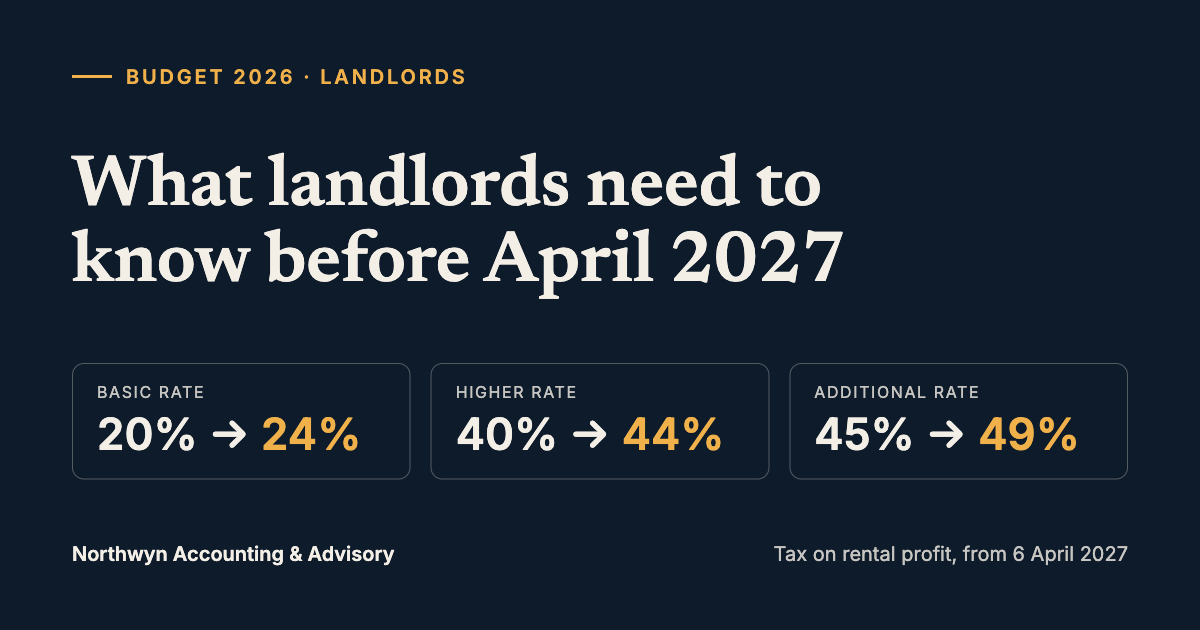
The short version: if you own rental property in your own name, your tax rate on rental profit rises to 24%, 44% or 49% from 6 April 2027. That is four percentage points higher than today, double the increase previously planned. Here is what changed, what it could cost you, and five moves worth making now.
What changed
Last year’s Budget set separate rates for property income, due to start in April 2027. Budget 2026 added a further two percentage points on top.
| Band | Today | Planned last year | From 6 April 2027 |
|---|---|---|---|
| Basic | 20% | 22% | 24% |
| Higher | 40% | 42% | 44% |
| Additional | 45% | 47% | 49% |
What could it cost you?
A quick example. It assumes the whole profit falls in one band and ignores the Personal Allowance, the £1,000 property allowance, other income and reliefs:
| Rental profit | Tax today | Tax from April 2027 | Extra |
|---|---|---|---|
| £10,000 (basic rate) | £2,000 | £2,400 | +£400 |
| £10,000 (higher rate) | £4,000 | £4,400 | +£400 |
| £20,000 (higher rate) | £8,000 | £8,800 | +£800 |
Who is affected?
- Affected — individuals receiving property income, including through partnerships. Trusts and estates have their own rates and rules.
- Where the rates apply — the 24%, 44% and 49% rates apply in England, Wales and Northern Ireland. Separately, legislation gives the Scottish and Welsh governments the ability to set their own property income rates, so landlords there should watch for announcements.
- Not hit by this rise — limited company landlords, who pay corporation tax instead. That does not make incorporation a quick fix.
- Capital gains — unchanged. Residential property stays at 18% and 24%, with a £3,000 annual exempt amount.
Five moves to make now
- Run your 2027/28 numbers — Estimate your rent, interest and costs, then see where your property income is likely to fall under the new rates. A small change in income can shift the result, particularly if you have employment, pension or other income alongside your rental profit.
- Review your allowable costs —Check you are capturing qualifying letting-agent fees, insurance, repairs, accountancy and compliance costs. Know the difference between a repair and a capital improvement, as the tax treatment differs.
- Look at who owns what — For jointly held property, the ownership position can affect how rental income is taxed. Any change must reflect genuine beneficial ownership and the wider legal position, so take advice before changing ownership for tax reasons.
- Get MTD-ready — Making Tax Digital for Income Tax already applies if your qualifying income (gross self-employment and property income, before expenses and allowances) is over £50,000. The threshold drops to over £30,000 from 6 April 2027 and over £20,000 from April 2028. HMRC sets your start date from an earlier year’s income: over £30,000 in 2025/26 means you start on 6 April 2027. If you are in scope, you need digital records and quarterly updates through compatible software, so check your start date on GOV.UK and choose software now. Partnerships are not yet in scope; HMRC will set their timetable later.
- Think hard before incorporating — A company can suit some portfolios, but compare the whole picture: tax in the company, tax on drawing profits out through dividends or salary, mortgage interest treatment, Stamp Duty Land Tax, capital gains tax on transferring existing properties, lender consent, and whether you intend to keep or extract the profits. Paying corporation tax is not the end of the story. It needs modelling, not a gut feeling.
Small print worth knowing
- The £1,000 property allowance stays. The trading allowance rises to £3,000, but that increase does not apply to the property allowance.
- From April 2027, the Income Tax ordering rules change so that, where possible, the Personal Allowance and other general reliefs are set against income other than property, savings and dividends first. If your salary already uses up your allowance, none is left for rental profit.
- Mortgage interest is still not deducted from rental profit for individual residential landlords. Instead, finance costs get a tax reduction linked to the property basic rate, which Budget 2026 sets at 24% from April 2027. Subject to the statutory finance-cost rules and limits, £8,000 of qualifying finance costs would give a £1,920 tax reduction. Higher-rate landlords can therefore still face a significant gap between the rate charged on their property income and the rate at which finance costs are relieved.
- Some measures need Finance Bill 2026-27 legislation, so check the final wording before making significant structural changes.
Not sure where you stand?
Send us three numbers — your annual rent, your allowable costs and your mortgage interest. We will show you your 2027/28 position, what is worth doing now, and what is not.
Book a free 30-minute discovery call or request a Tax Health Check at northwyn.co.uk, email hello@northwyn.co.uk or call 07443 021316 before the new tax year begins.
Sources
- HMRC, Budget 2026: Annex A, rates and allowances (property rates, CGT rates)
- HMRC, Sole traders and landlords earning more than £30,000 urged to act now (MTD thresholds and sign-up)
- GOV.UK, Find out if and when you need to use Making Tax Digital for Income Tax (start dates, partnerships)
- GOV.UK, Income Tax: changes to tax rates for property, savings and dividend income (who is affected, England, Wales and Northern Ireland scope, devolved powers, allowance ordering)
- PKF Francis Clark, Autumn Budget 2026: property income (property and trading allowances)
This article is general information, not personal tax advice. It reflects Budget announcements and HMRC guidance available at 1 November 2026. Legislation for some measures is still to come, so details may change.